
Table of Contents
- The Body Is the First Gate
- Wude: The Foundation from the Beginning
- The Mind: Where Kung Fu Becomes More Than Exercise
- The Same Progression Exists Inside the Physical Training
- The Spirit: What the Deeper Side of Shaolin Really Looks Like
- Warrior Monks and Scholar Monks: Different Paths, Similar Progression
- How Shaolin Differs from Some Other Martial Traditions
- What This Means at Maling Shaolin Kung Fu Academy
- How Students Can Approach the Spiritual Side of Shaolin Training
- The First Meditation Hall Is the Body
Many students arrive at a Shaolin kung fu school with a very specific image in mind.
They imagine quiet courtyards, incense, and meditation; perhaps flowing robes, mysterious conversations about qi, or masters speaking in deep philosophical riddles. Especially for students coming from the West, there is often an expectation that a traditional kung fu school in China will feel like a “super zen” environment, where people are constantly meditating, discussing energy, and exploring the spiritual side of martial arts from the very beginning.
And to be clear, the spiritual side of Shaolin is real.
Shaolin kung fu is not only physical exercise. It is rooted in a long cultural, martial, and Buddhist tradition. Qigong, meditation, breath, intention, discipline, humility, and self-cultivation are all part of the greater Shaolin path. At Maling Shaolin Kung Fu Academy, we do have qigong and meditation classes. Masters may speak about qi, intention, breath, relaxation, focus, or how to use internal energy in certain moments of training.
But daily training is still very physically focused.
For some students, this can be surprising. They expected more stillness, more philosophy, more spiritual discussion. Instead, they find themselves running, stretching, sweating, holding stances, repeating basic movements, learning forms, correcting posture, and trying to survive sore legs.
But this is not because the spiritual side is missing. It is because in Shaolin, the spiritual path usually begins in a much more practical place: the body.
A simple way to understand this progression is:
First, train the body.
Then, train the mind.
Then, cultivate the spirit.
This is, of course, an oversimplification. In real training, body, mind, and spirit are never completely separate. They overlap, support each other, and develop together. A beginner is already learning mental discipline. A physical movement can already contain spiritual meaning. A senior practitioner still trains the body.
But as a general pattern, this body–mind–spirit progression follows the natural order of Shaolin training, and in many ways, the natural order of human development itself.
The Body Is the First Gate
Traditionally, many students who began Shaolin training were very young. A child of five, six, seven, or eight years old is not ready to meaningfully discuss enlightenment, emptiness, non-attachment, Buddhist philosophy, or the relationship between the self and the universe.
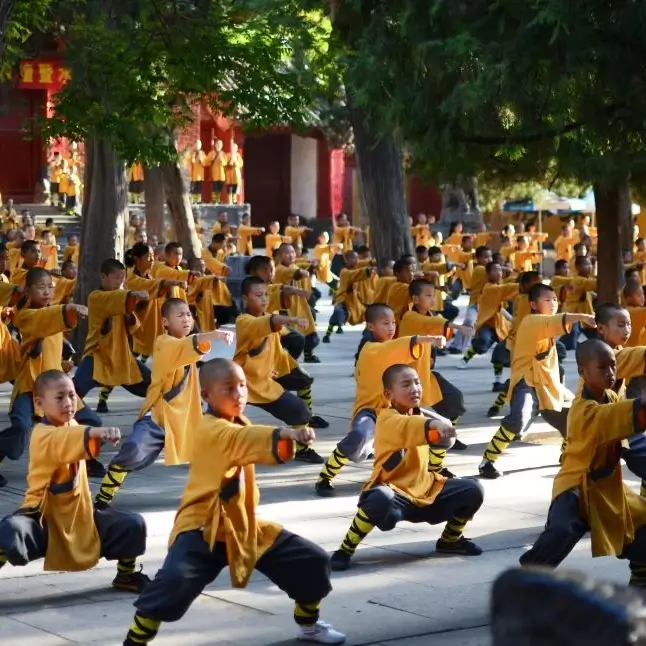
But a child can understand the body.
They can understand standing lower.
They can understand stretching farther.
They can understand running faster.
They can understand balance, coordination, pain, effort, correction, and repetition.
They can understand, “Try again.”
This is one of the reasons Shaolin training begins physically. The body is the first tool a student has. It is the most immediate teacher. Before a student can understand stillness, they must first meet discomfort. Before they can understand inner peace, they must first face impatience, fatigue, frustration, weakness, and ego.
In Shaolin, the body is not separate from the spiritual path. The body is the first gate.
When a student holds mabu, the horse stance, they may think they are only training the legs. But very quickly, the legs are not the only thing being tested. The mind begins to complain. The breath becomes unstable. The emotions rise. The student begins to negotiate with themselves.
“Can I stand a little longer?”
“Can I stay calm?”
“Can I stop thinking about how much I want this to end?”
“Can I listen to correction even when I am tired?”
“Can I continue without anger, drama, or giving up?”
At first, the training looks physical. But hidden inside the physical training is the beginning of mental training.
This is why Shaolin does not need to begin with long spiritual lectures. The first lesson is already happening in the body.
Wude: The Foundation from the Beginning
This does not mean that values, ethics, and character are delayed until later.
In Shaolin kung fu, martial virtue, or Wude (武德), is expected from the beginning. Respect, humility, patience, discipline, honesty, self-control, compassion, and proper conduct are not optional “advanced spiritual concepts.” They are the foundation that allows a student to train safely and sincerely.
A student who lacks respect cannot learn properly.
A student who lacks humility cannot receive correction.
A student who lacks self-control cannot be trusted with combat skills.
A student who lacks patience will quit before the deeper lessons appear.
So when we say Shaolin often progresses from body to mind to spirit, we are not saying that morality begins only at the spiritual stage. Wude is present from the first day. It is the baseline of training.
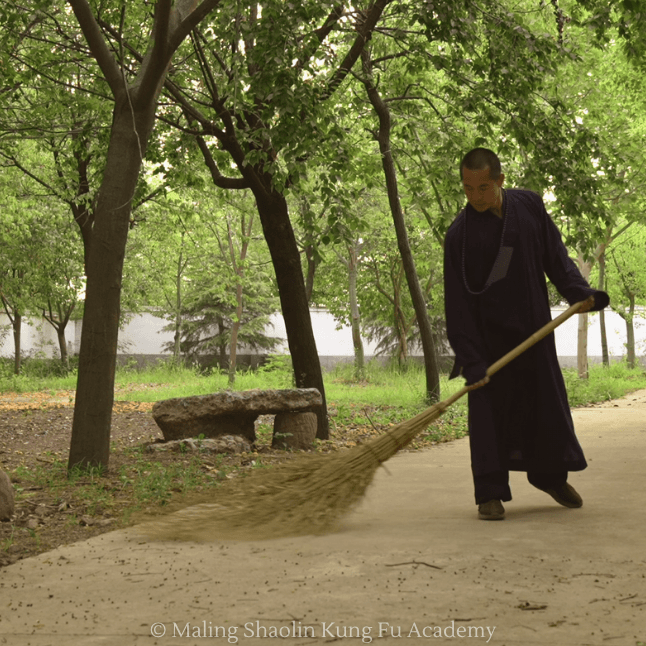
However, in Shaolin, we may not always call this “spirituality” in the way many Western students expect. A student bowing to the master, respecting senior students, listening carefully, cleaning shared spaces, controlling their temper, or practicing safely with others may not feel like a mystical or spiritual experience. But these actions are part of the moral foundation of kung fu.
They are also deeply connected to Chinese culture more broadly.
Shaolin developed within a Chinese cultural world shaped not only by Buddhism, but also by Confucian values such as respect for elders, respect for teachers, proper behavior, humility, duty, and social harmony. In daily training, this can appear very simply: listen when the master speaks, show respect to those who came before you, do not show off carelessly, do not endanger others, and understand that your behavior reflects not only yourself but also your school, your teacher, and your tradition.
These values are not separate from training. They are what make training possible.
The Mind: Where Kung Fu Becomes More Than Exercise
After the body begins to develop, the mind becomes the next great challenge.
At first, a new student often feels excited. Everything is new. Every movement feels interesting. Progress can come quickly because the student is learning basic skills for the first time: stances, kicks, punches, jumps, forms, flexibility, coordination, and strength. The beginner stage can feel full of discovery.
Then, for many students, something changes.
Training becomes repetitive. The body becomes tired. The first wave of excitement fades. Progress no longer feels as fast or obvious. The student may begin to wonder:
“Am I improving?”
“Is this really for me?”
“Why am I repeating the same basics again?”
“Why does this still feel difficult?”
“Where is this going?”
“Do I actually want to continue?”
This is one of the most important stages of kung fu training.
Many masters describe this as something almost everyone goes through. The beginning is exciting because everything is new. But real kung fu is not built only during the exciting stage. Real kung fu begins when the student reaches the flat, frustrating, repetitive stage and chooses to continue anyway.
This is not only about physical endurance. It is about mastering motivation, purpose, and patience.
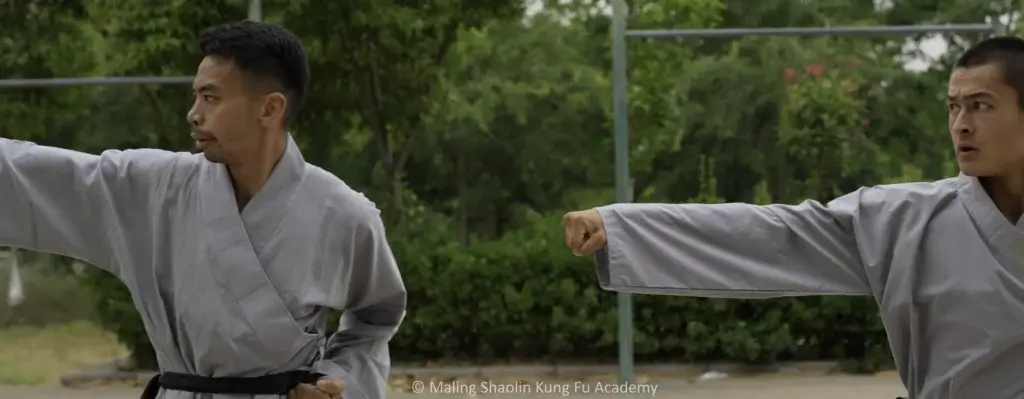
The student must learn how to continue when the training no longer feels romantic. They must find a deeper reason to practice. They must learn to love the process, not only the visible progress. They must understand that repetition is not a sign that training has become meaningless. Repetition is where meaning begins to deepen.
In the early stage, improvement can be obvious. A beginner may learn many new things quickly. But the longer someone trains, the more subtle progress becomes. The corrections become smaller. The standards become higher. Instead of simply learning a new kick, the student may spend months improving the angle of the hip, the position of the foot, the timing of the breath, the stability of the landing, or the quality of power.
To an outsider, this may look like slow progress. To a kung fu practitioner, this is where real progress begins. The body has learned the rough shape. Now the mind must learn patience, refinement, and intention.
This is why we often say that the body can only go as far as the mind allows. If the mind is weak, impatient, prideful, or easily discouraged, the body will eventually stop progressing. But when the mind becomes stronger, the student’s possibilities expand.
Can I keep going when I am tired?
Can I stay calm when I am frustrated?
Can I listen to correction without ego?
Can I repeat basics without boredom?
Can I control fear, impatience, laziness, anger, and self-doubt?
Can I keep training even when progress is no longer obvious?
This is the second gate of Shaolin.
The student is no longer only training muscles and tendons. They are training intention, willpower, humility, patience, concentration, emotional control, and purpose.
The Same Progression Exists Inside the Physical Training
This body–mind–spirit progression is not only a broad life philosophy. It also appears inside the practical structure of Shaolin training itself.
A student does not begin with the most dangerous or complex skills. They begin with basics.
First, they learn how to stand.
Then, they learn how to step.
Then, they learn how to kick, punch, turn, jump, fall, and coordinate the body.
Only after this foundation do they begin to handle more advanced forms or weapons.
There is a reason empty-hand basics come before weapons. A student must first understand their own body before they can safely extend that body through an object. They need balance, coordination, distance, control, awareness, and discipline.
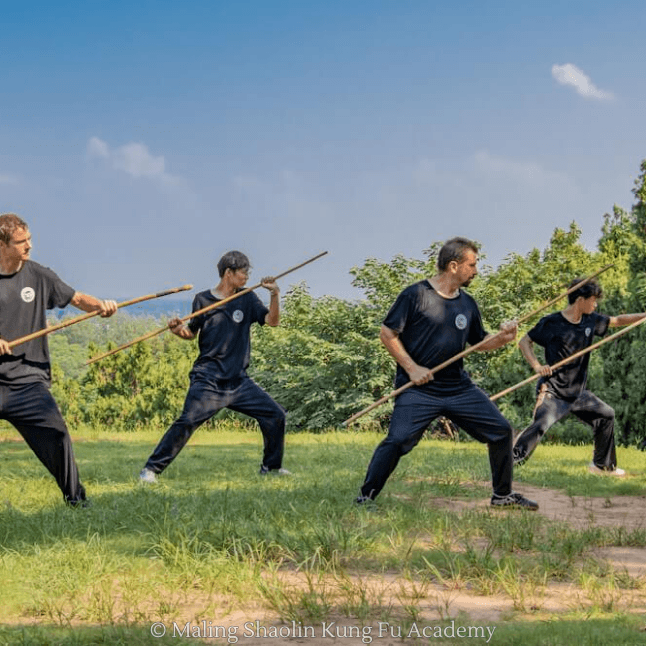
In many Shaolin schools, the staff is the first weapon students learn. This is not accidental. The staff has no blade. It teaches range, coordination, power, rhythm, body mechanics, and how to move with a weapon as an extension of the self. Before a student handles something sharper, heavier, more flexible, or more dangerous, they must first learn control.
Bladed weapons require more awareness. Flexible weapons require even more. Soft weapons such as the three-section staff demand a much deeper understanding of timing, distance, relaxation, safety, and the relationship between body and weapon. A student who cannot control their own movement cannot safely control a weapon.
This reflects the same principle: development must follow order.
You do not begin with the most mysterious spiritual teaching.
You do not begin with the most dangerous weapon.
You do not begin with the most advanced form.
You begin with the body.
You build the foundation.
You learn control.
You develop the mind.
Only then can you safely and meaningfully approach the deeper levels.
In this way, Shaolin training is not random. The order itself teaches wisdom.
The Spirit: What the Deeper Side of Shaolin Really Looks Like
The spiritual side of Shaolin is real, but it may not look the way students expect.
It is not always dramatic.
It is not always verbal.
It is not always mystical.
It is not always separate from training.
In Shaolin, spirituality is often embodied. It is practiced through movement, breath, discipline, humility, compassion, restraint, and the gradual transformation of the self.
A form is not automatically spiritual just because it is old or Chinese. The same punch, stance, or weapon movement can be used for performance, combat, health, discipline, or spiritual cultivation. The movement itself is only one part. The deeper meaning depends on the practitioner’s intention, understanding, training environment, and inner state.
For a beginner, a form may simply be choreography.
For a stronger student, it may become power and coordination.
For a more experienced practitioner, it may become expression, breath, timing, and intention.
For someone who has trained deeply for many years, it may become a form of meditation in motion.
This is why the spiritual side often comes later. Not because it is being hidden, but because the student may not yet have the tools to recognize it.
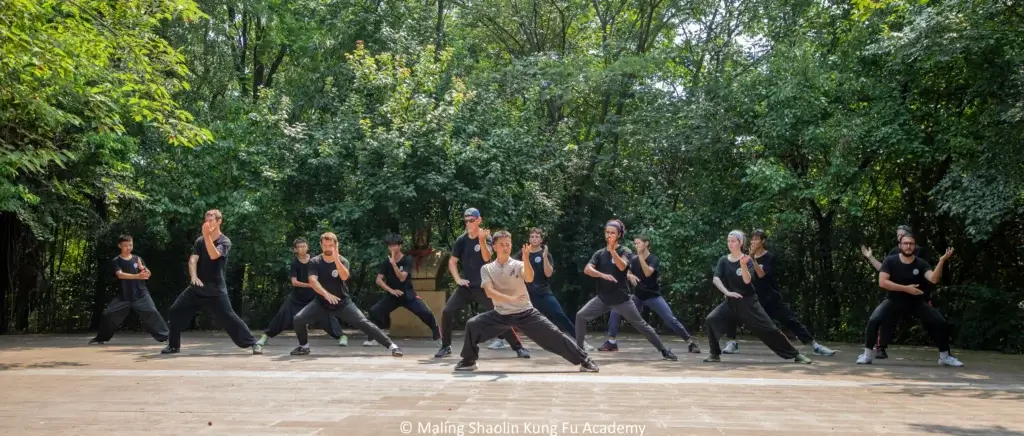
Spiritual cultivation requires stillness, patience, awareness, and depth. But early Shaolin training is often the opposite of stillness. It is movement, effort, sweat, correction, and physical challenge. The beginner’s mind is usually busy surviving the training. Only later, after the body becomes stronger and the mind becomes steadier, can the student begin to feel the quiet inside the movement.
This is one of the beautiful paradoxes of Shaolin:
Stillness is not the opposite of movement.
Stillness is what movement eventually teaches.
Warrior Monks and Scholar Monks: Different Paths, Similar Progression
At the Shaolin Temple, the path of the warrior monk and the path of the monk focused more on Buddhist study or temple life may look very different.
The warrior monk, or wuseng (武僧), trains through martial practice. His path is physical, demanding, disciplined, and embodied. Through kung fu, he trains the body, strengthens the mind, and gradually cultivates Chan understanding through movement, hardship, breath, repetition, and self-control.
For the warrior monk, martial practice can become a road into spiritual cultivation.
The scholar monk or ordained monk may follow a different emphasis. His path may focus more directly on Buddhist study, chanting, meditation, temple duties, ritual life, scripture, and religious discipline. Often, such monks enter this path as adults or after already experiencing much of ordinary life. They may have passed through worldly responsibilities, ambitions, hardships, disappointments, or turning points before choosing to dedicate themselves more fully to spiritual cultivation.
The outward paths are different, but the deeper pattern can be similar.
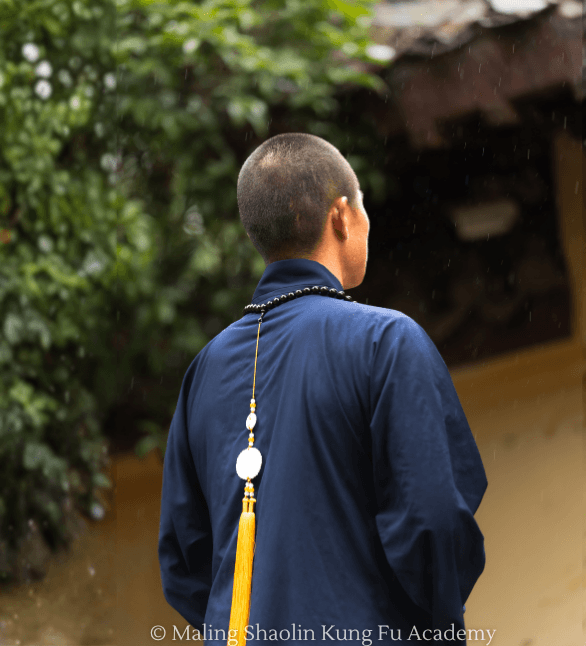
First, a person experiences the world through the body.
Then, they struggle, decide, reflect, and mature through the mind.
Then, they turn toward deeper questions of meaning, spirit, liberation, compassion, and self-cultivation.
For the warrior monk, the body is trained directly inside the temple martial tradition.
For the scholar or ordained monk, the body and mind may have already been shaped by ordinary life before entering the religious path.
But in both cases, spiritual cultivation is not childish fantasy. It is not a costume, a performance, or an aesthetic. It is something that requires maturity.
This is one reason young martial students are not usually taught as if they are already spiritual sages. They are taught to train, behave, endure, listen, and grow. The deeper understanding comes with time.
How Shaolin Differs from Some Other Martial Traditions
Different martial traditions place spiritual, ritual, or philosophical elements in different positions.
In some traditions, ritual may be visible from the very beginning. For example, in Muay Thai, students and fighters may encounter ceremonial practices such as Wai Kru or Ram Muay, which visibly express respect for teachers, lineage, tradition, gratitude, and protection. In many Japanese budo traditions, etiquette, bowing, formal conduct, and philosophical ideas about character development are also highly visible from the beginning.
Shaolin has these values too.
Respect, humility, discipline, gratitude, proper conduct, and reverence for the teacher are not absent from Shaolin. In fact, they are fundamental. Wude is expected from the start, and Chinese cultural values around respect, courtesy, and hierarchy are deeply woven into the training environment.
The difference is not that Shaolin lacks values. The difference is often in how the deeper spiritual side is approached.
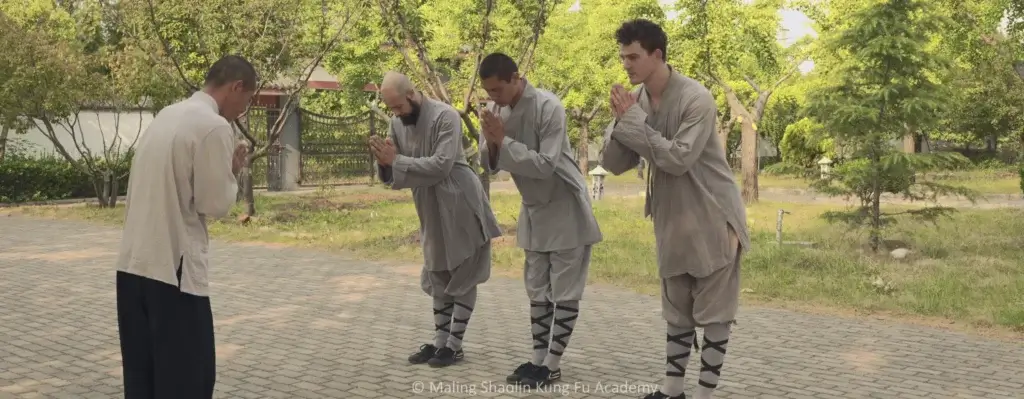
In many modern Shaolin schools, especially those focused on martial training, the spiritual side may be less ceremonial and less verbal at first. It may not be introduced through constant discussion, visible ritual, or formal philosophical teaching every day. Instead, it is hidden inside repetition, hardship, etiquette, breath, correction, patience, and the long transformation of character.
The student may not hear a lecture about humility every morning. They may simply be corrected again and again until they learn it.
They may not be told to meditate on patience. They may simply be asked to hold the stance longer.
They may not receive a long explanation about ego. They may simply realize, after months of frustration, that ego is what prevents them from learning.
This is Shaolin’s quiet method.
It does not always explain the lesson before the student experiences it. Often, it lets the body and training reveal the lesson first.
What This Means at Maling Shaolin Kung Fu Academy
Maling Shaolin Kung Fu Academy is not the Shaolin Temple itself, and it is not a monastery. Students who come here should not expect the daily life of ordained monks, Buddhist scripture study, temple rituals, or a fully religious environment.
Maling is a kung fu school rooted in Shaolin martial tradition.
That means the training is practical, physical, and disciplined. Students come here to train Shaolin kung fu, qigong, forms, basics, weapons, flexibility, strength, and endurance. The daily schedule is centered around martial development.
But that does not mean the deeper side is absent.
It is present in the way students train.
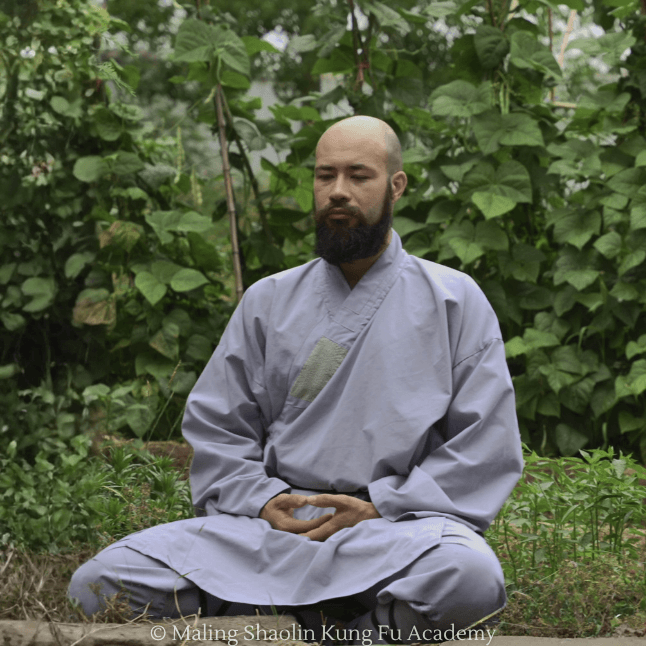
It is present in qigong and meditation.
It is present in respect for the master.
It is present in cleaning duties and shared life.
It is present in learning to live with others.
It is present in controlling emotions during hard training.
It is present in humility when corrected.
It is present in continuing when the body is tired and the mind wants to quit.
For a short-term student, the spiritual side may appear only in small glimpses. A calmer breath during qigong. A moment of focus during a form. A little more patience during stretching. A better attitude during correction. A realization that training is not only about learning movements, but also about changing one’s relationship with discomfort.

For a long-term student, these lessons become deeper.
At first, kung fu is something you do.
Then, it becomes something you practice.
Then, slowly, it becomes something that changes how you think, move, react, and live.
This is where the spiritual side begins to appear.
Not as something separate from training, but as something revealed through training.
How Students Can Approach the Spiritual Side of Shaolin Training
For students who come to Maling hoping to experience the deeper side of Shaolin, the best approach is not to chase mystical experiences. It is to train sincerely.
Treat basics as meditation.
When repeating a stance, punch, kick, or form, do not think of it as “just basics.” Pay attention to breath, posture, intention, and awareness. The basics are where the mind is trained.
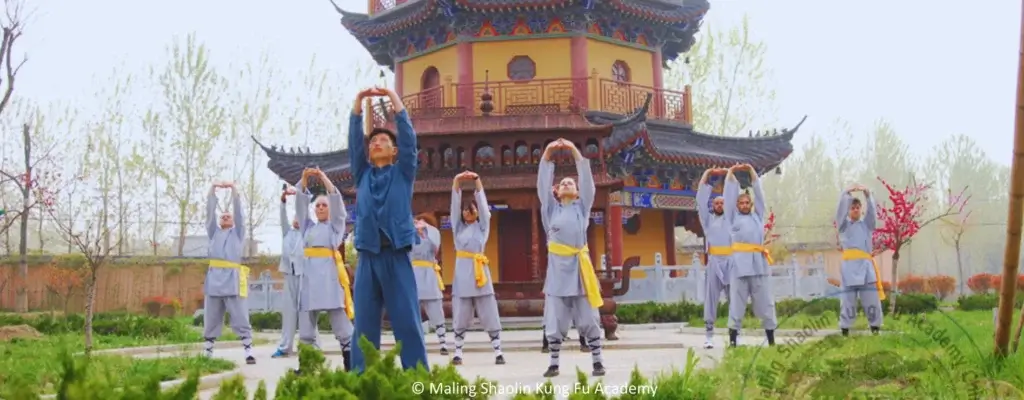
Use qigong to connect body and breath.
Qigong is one of the clearest bridges between physical and internal training. It teaches the student to slow down, breathe, relax, feel the body, and become aware of internal tension. For many students, qigong is where they first begin to understand that strength is not only muscular.
Practice humility during correction.
Correction is one of the most important spiritual tools in kung fu. It reveals ego immediately. A student who becomes defensive, embarrassed, angry, or discouraged when corrected has found exactly what they need to train.
Observe your reaction to difficulty.
Hard training shows a person to themselves. Do you become impatient? Do you complain? Do you compare yourself to others? Do you give up quickly? Do you become careless when tired? These reactions are part of the training.
Respect the process.
The deeper side of Shaolin cannot be rushed. It is not something a student receives after one meditation class or one conversation about qi. It develops through time, sweat, patience, and sincere effort.
Understand that spirituality may look ordinary.
Sometimes the spiritual lesson is not dramatic. Sometimes it is simply cleaning the training hall properly. Standing in line respectfully. Helping another student. Accepting correction. Breathing calmly. Bowing sincerely. Trying again.
This is why Shaolin spirituality is often misunderstood. People look for it in mysterious places, but often it is hidden in plain sight.
The First Meditation Hall Is the Body
Many students come looking for peace, but Shaolin first gives them discipline.
At first, this can feel disappointing. Discipline is not as romantic as enlightenment. Repetition is not as exciting as mystery. Stance training does not feel as spiritual as meditation under a mountain waterfall.
But over time, the student begins to understand.
The body is not a distraction from spiritual practice.
The body is the first tool of spiritual practice.
Through the body, the student meets discomfort.
Through discomfort, the student meets the mind.
Through the mind, the student meets ego, fear, impatience, and limitation.
Through years of sincere practice, the student may begin to meet something deeper.
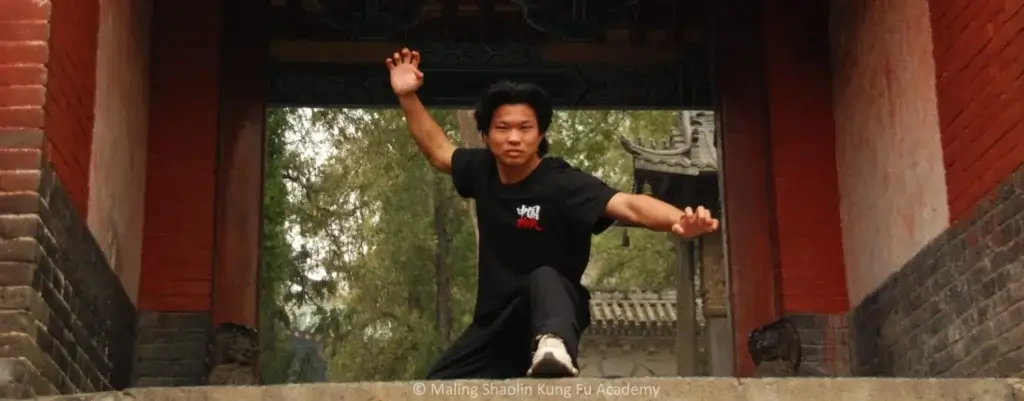
In Shaolin, kung fu does not begin with enlightenment. It begins with repetition.
It begins with standing lower, trying again, breathing through discomfort, listening to correction, and slowly becoming the kind of person who can receive deeper teachings.
The spiritual side of Shaolin is not hidden because someone refuses to teach it. It is hidden because, at first, most students are not ready to recognize it. But if they keep training, the meaning begins to appear.
In the stillness after movement.
In the breath after exhaustion.
In the humility after correction.
In the patience after frustration.
In the quiet strength that grows when body, mind, and spirit slowly begin to move as one.
That is the path from strength to stillness.
And in Shaolin, that path begins with the body.